An iris is too
Some irises are pink
But this one is blue
flickr photo by tanakawho shared under a Creative Commons (BY-NC) license
An iris is too
Some irises are pink
But this one is blue
flickr photo by tanakawho shared under a Creative Commons (BY-NC) license
There’s a saying that is (apparently) falsely attributed to Buddha, which says that:

teacher appears flickr photo by NomadWarMachine shared under a Creative Commons (BY-NC-SA) license
I was reminded of that during the latest #MoocMooc chat when Mark said that:
@Jessifer@jasoncummings1@NomadWarMachine@yishaym@slamteacher Much f2f is about control / design online to lose control #moocmooc
— Mark Johnstone (@mcjsa) February 11, 2016
And Yishay replied to my tweet asking for clarification by saying that:
@NomadWarMachine @mcjsa @Jessifer @jasoncummings1 @slamteacher I think he means you so should design yourself out of control. #moocmooc
— Yishay Mor (@yishaym) February 11, 2016
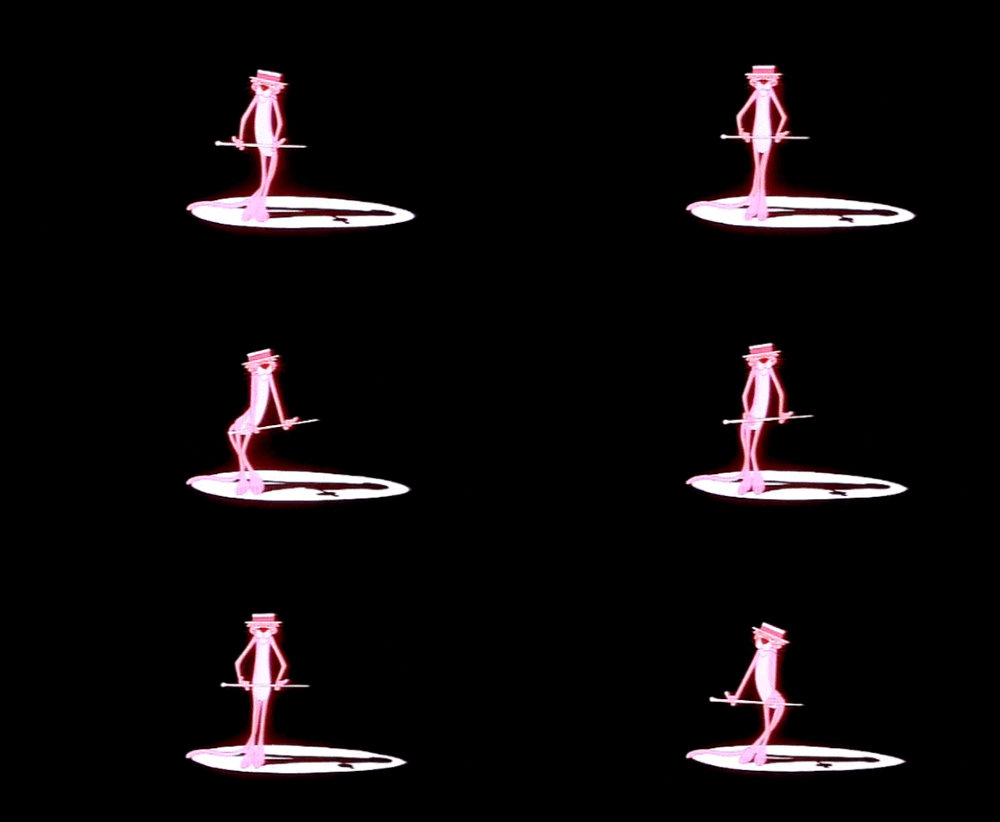
Quick as a flash, I replied with my version of this saying:
@yishaym @mcjsa @Jessifer @jasoncummings1 @slamteacher Like a Cheshire cat? #MoocMooc pic.twitter.com/Fbk1mWC8Xw
— Sarah Honeychurch (@NomadWarMachine) February 11, 2016
So what’s better? A teacher who waits in the wings till students need them, or one who “softly and silently vanishes away” when they are no longer needed? Or, rather, which is better when?
Flickr images by me under a CC-BY-NC-SA 3.0
It’s easy to bash the VLE (Virtual Learning Environment). I’m not going to pretend that it is a universal panacea for online or blended learning, but it is not as bad as some folk make out. I think it’s easy to forget just how difficult it can be to start out putting together online materials, and to keep up with this when it is only a small part of one’s workload (and when senior staff are oblivious to the time needed to produce good elearning materials, or to make realistic estimates of what percentage of one’s workload model it should be). So here’s a few points in defence of the VLE:
So I’m not saying that this represents the best that teaching and learning can be, but I do think that we need to be realistic. By all means go beyond the VLE in your own teaching and learning, but don’t belittle those who are not as able or as confident as we are out in the wilds of the internet.
flickr photo by ShawnKimball shared under a Creative Commons (BY-NC-SA) license
I’m in love with Hypothes.is, a free online annotation tool which allows you to easily highlight bits of text and comment on them, and then to share those comments publicly if you wish so that others can see them and join in the conversation. To use it, either drop a link to a web page into their web page or download the Chrome extension (I prefer this). Yesterday I annotated one of Terry’s blog posts and tweeted for others to join in, and at the moment we’re also annotating some of Simon’s including this.
It’s fun to do this, and to have an asynchronous conversation with friends, and it’s a lot more intimate than leaving a comment at the bottom of a blog post (and sometimes that is not even possible, as some folk turn the comments off). Come and join in, if you like, or tweet me a link to something you’d like to annotate. 🙂
flickr photo by findingthenow shared under a Creative Commons (BY-NC-SA) license
I don’t draw – I can doodle, but it’s nothing special. So Karen’s postcard writing challenge was – well – a challenge for me. I bought some coloured card and dithered for ages about what to do: potato prints? collage? photos? Nothing seemed right. Then I remembered an article I’d seen before Christmas and I knew I’d found what I wanted to make. I had a lot of embroidery thread in my sewing table, so I tipped it all out and set to work.

Card and protractor flickr photo by NomadWarMachine shared under a Creative Commons (BY-NC-SA) license

Cards and thread flickr photo by NomadWarMachine shared under a Creative Commons (BY-NC-SA) license
I began with a triangular design, got bored after 8 of those and tried some star-like shapes. Finally I tried a six pointed design, which I was really pleased with – but I had enough to send now, so packed up my tools and glued them down.

Parabola cards flickr photo by NomadWarMachine shared under a Creative Commons (BY-NC-SA) license
Finally I opened the Google Sheet and addressed all of the envelopes, wrote messages and sealed them up.

Envelopes flickr photo by NomadWarMachine shared under a Creative Commons (BY-NC-SA) license
Next to remember to post them!

Pieter Brueghel the Elder – The Blind Leading the Blind flickr photo by Gandalf’s Gallery shared under a Creative Commons (BY-NC-SA) license
Thoughts without intuitions are empty, intuitions without concepts are blind. Immanuel Kant: Critique of Pure Reason, B 75
Kant wrote the above in order to call for a metaphysics that is both synthetic and a priori – i.e. a metaphysics that uses both reason and experience – i.e. a metaphysics that uses intuitive concepts. It’s not important here exactly what that means, I use this to illustrate the futility and wrong-headedness of those who argue for practice without theory, or theory without practice – because
Theory without practice is empty, practice without theory is blind.
I’ve been reading a paper by D.C. Phillips today entitled The Good, the Bad, and the Ugly: The Many Faces of Constructivism and I realise that this is actually a moral point. Phillips uses the example of Ernst von Glasersfeld, who (he says) uses a weak epistemological theory in order to argue for his particular pedagogical theory (or, quite possibly, chooses the epistemology as it allows him to articulate his beliefs about pedagogy). That seems to be doing an injustice to his students – doesn’t it?
So what if you are the sort of person who does not think that theory is important – how are you going to ensure that you don’t hurt your learners with your unreflective practice? I just don’t see how anyone can really believe that, at some level, theory is not important.
In the words of the immortal Sinatra, you can’t have one without the other.
Last week as I walked past our university library I spotted a kangaroo lurking. This week I remembered to snap a pic. Unfortunately there has been a lot of rain and it has a big puddle of water around it. Poor roo looks as if they have been caught short 😉

kangaroo flickr photo by NomadWarMachine shared under a Creative Commons (BY-NC-SA) license
The kangaroo reminded me of all my Australian friends, and I wondered how the weather was over there. I arrived home to a card from Wendy:
Yesterday it snowed. By lunchtime the view from my bedroom window was this:

snow houses flickr photo by NomadWarMachine shared under a Creative Commons (BY-NC-SA) license
One thing that surprised me was how the houses, which usually look white, look such a dirty yellow at the moment. Colour’s all relative, I guess.
The birds looked hungry this morning:

empty birdfeeders flickr photo by NomadWarMachine shared under a Creative Commons (BY-NC-SA) license
Niall has since filled these so the wee birds that visit our garden can find a tasty feast. The blackbirds also love these berries:

red berries flickr photo by NomadWarMachine shared under a Creative Commons (BY-NC-SA) license
It looks lovely at the moment, but it is also very cold.
There’s a theory in the Philosophy of Religion called religious pluralism, which has many variations, one of which is the belief that no one religion has got it right, but that parts of different religions can be combined to find the Truth. Many years ago a friend alerted me to another term that was used for one version of this theory of religion – cafeteria pluralism. Gregory Bassham, who I believe originally coined this term, thought that he could use this to form an objection to a pluralist theory, but it’s not clear to me that it is. 1
According to Bassham, the cafeteria pluralist “eclectically picks and chooses themes and doctrines from the various religious traditions to create an idiosyncratic personal religion” – and I like to call this a “Pick n Mix” theory of religion. Sometimes I think about who my personal god(dess) would be – a combination of the trickster Loki, the wisdom of Athena, the energy of Vishnu – you get the idea. But I digress.
So why am I writing about this? Well, because of a conversation we’ve been having on Twitter about D&G, where this happened:
@kwhamon @davecormier @NomadWarMachine ah. New reading strategy. Pick quotes out of context n hope they make sense 🙂 lemme try it #rhizo16
— ℳąhą Bąℓi مها بالي (@Bali_Maha) January 9, 2016
Then Simon said that all reading and quoting was out of context, and I replied with “pick n mix theory of learning” and then I remembered how I’d used it before. Now I’m going to extend it and use it for any philosophy, not just philosophy of religion.
There’s a theory of knowledge which I am drawn to which is called coherentism, which I have written about before. According to my very superficial reading, coherentism is a theory of knowledge for a rhizomatic thinker. Unlike foundationalism, which is arborescent in its belief that there is one fundamental truth or set of truths which underpin all knowledge, coherentism sees knowledge as a web of belief, where things are justified by their consistency to other beliefs in the system. So we can have our own pick n mix version of philosophy – a bit of Hume, some Lucretius maybe and then Spinoza, Bergson and Nietzsche, for example, with a nod to Kant and a shake of the head at Hegel.2
So there we have it – a pick n mix theory of philosophy. It doesn’t matter what the original writer meant, it’s how it fits in with your theory that matters.
flickr photo by Route79 shared under a Creative Commons (BY-NC-SA) license
flickr photo by SammCox shared under a Creative Commons (BY-NC) license